Here’s Today’s Tip… Change. “Everyone thinks of changing the world, but no one thinks of changing himself.” – Leo Tolstoy Everything begins with a belief. As Ralph Waldo Emerson once said, “Life consists of what a man is thinking about all day.” Along those lines, what we think determines who we are. And who we are determines what we do. Our thoughts determine our destiny, and our destiny determines our legacy. As British philosopher James Allen, author of “As a Man Thinketh”, said, You are today where your thoughts have brought you. You will be tomorrow where your thoughts take you.” People who go to the top think differently than others. Said differently, small thinking is self-limiting. It holds you back from achieving great things. On the other hand, nothing expands possibilities like unleashed thinking. The good news: We can change the way we think. Believe it or not, the #1 challenge to making personal changes is your feelings. And you can control your feelings by controlling your thoughts. In other words, you can control your thoughts, and your feelings come from your thoughts. Unfortunately, because few people control their thinking, they fail to control their lives. How can you change your thoughts? Think big picture. This allows you to see beyond yourself. Think focused. This allows you to remove distractions. Think creatively. This allows you to get out of your box of limitations. Think realistically. This allows you to have a foundation for change. Think strategically. This allows you to have a plan for change. Think possibilities. This allows you to look for and receive the best. Think reflectively. This allows you to gain a true perspective of yourself. Long story short, what we think informs what we believe, for belief is a byproduct of what we’ve thought about long enough and decided to buy into. Our beliefs inform our expectations, which impact our attitude. Attitude to behavior, behavior to performance, and changing your performance changes your life. If you followed along there, you see that everything is traced back to our thoughts. To Your Change, Change That Up Before I go, quick question… Are You taking Vitamin C in a tablet form?Studies show you’re better off flushing your money down the toilet if you make THIS mistake… You see, most people buy vitamin C pills or capsules and they DO NOT receive the benefits of those vitamins as a majority of the nutrients are not absorbable in the stomach…
However, there is a NEW patented liposomal technology for Vitamin C that is clinically PROVEN to be more absorbable and delivers the nutrients straight into the bloodstream!
These three scenarios have one thing in common. Can you guess it?
You just finished exercising, and your mom left you a voicemail. “Hi honey. Can you take me to the doctor tomorrow at 11 a.m.?” You have an important work call then, but you know she’ll be upset if you can’t do it.
It’s 10 p.m. and your phone buzzes. It’s an email from a new client. You’re already in bed and about to turn off the lights, but you know he expects a reply before morning.
You see the texts roll in like rapid fire. It’s your friend venting about her breakup for the third time in four days. You want to make sure she feels supported, but you feel too swamped with work to reply.
The uniting thread: You feel like your boundaries are being crossed.
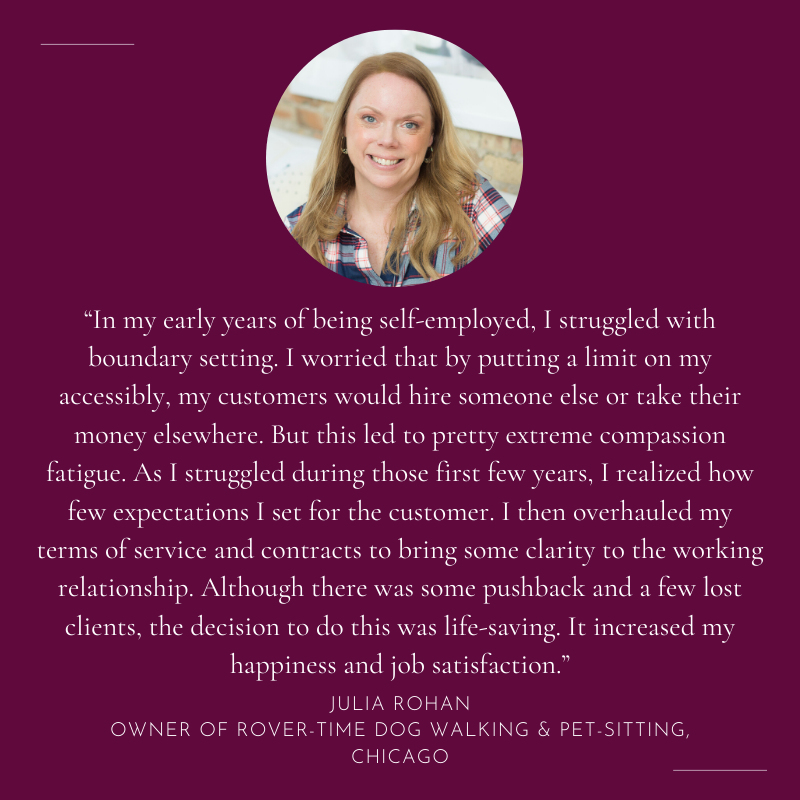
Setting healthy boundaries comes naturally for some people. For others, it can be a struggle. But regardless of your proficiency for it, one thing is true: If you’re self-employed, have a side hustle or don’t work 9-to-5, establishing boundaries is not just important—it’s imperative. After all, when you don’t work in a traditional office or you work for yourself, people often assume you have more flexibility or free time than you actually do.
“One of the risks of not setting boundaries is that you overextend yourself; you agree to all kinds of things, personal and professional,” says Ramani Durvasula, Ph.D., a professor of psychology at California State University, Los Angeles, and a licensed clinical psychologist. “At the end of the day, the person who gets hurt by that is you. It’s a really important piece of self-preservation, self-respect and self-care to be able to set healthy boundaries.”
Read on for a step-by-step guide to establishing boundaries, both personally and professionally.
Step 1: Identify whether your boundaries are being crossed.
It can often be difficult to determine when a boundary has been violated.
Durvasula says someone’s ability to notice boundary violations can often be traced back to their upbringing. If your family had poor boundaries, for example, you might find it particularly difficult to detect when your boundaries are being crossed as an adult.
Luckily, there are a few surefire ways to identify when your boundaries are being violated.
You have a gut feeling. “We often feel boundary violations physiologically,” Durvasula says. “They make us uncomfortable. It’s like our gut is talking to us.”
Many of us will try to talk ourselves out of the uncomfortable feeling, she says. Oh, you’re just being silly, we think. If I say no, I’ll be so mean, we rationalize. But if our intuition says a boundary is being violated, it most likely is.
You notice uncomfortable emotions popping up. Shannon Curry, a licensed clinical psychologist based in Newport Beach, California, says a few key emotions might indicate that your boundaries are being encroached upon. You might:
Feel resentful toward the other person.
Feel guilty if you don’t comply with something asked of you.
Feel like you’re being imposed upon.
Feel taken advantage of.
Feel violated or angry.
“It could even be difficult to articulate what the emotion is,” Curry says. “And that could mean a personal boundary has been encroached upon.”
The relationship feels unbalanced. If you feel like you’re giving disproportionately more to someone else, you could be struggling with a case of inappropriate boundaries.
“When boundaries are being violated, the relationship will start to feel one-sided,” Durvasula says. “It’ll feel very unbalanced.
Step 2: Know the benefits of setting better boundaries.
Establishing boundaries is far from easy. It’s a delicate and nuanced process that requires practice and mental fortitude. Because of this, people often struggle to take action—even if they’ve noticed burgeoning feelings of anger, resentment or guilt.
“There’s a moment at the beginning where setting boundaries is so uncomfortable for people, they’re like, to hell with this, I’d rather do everything myself than feel this uncomfortable,” Durvasula says. “But if they can endure the discomfort of boundary setting, they can really get themselves to a place where they can respectfully say no.”
One way to push through the initial discomfort is to picture the countless benefits you’ll reap as a result of protecting and preserving your time.
If you’re self-employed or have a side hustle and attempt to set better boundaries with family and friends, you could grow your business. Or, if the opposite is true—meaning you need to set better boundaries with clients in order to protect your personal time—you’ll experience conserved emotional energy for the people who truly matter to you, not to mention countless other benefits.
“What you can look forward to is a life that’s created based on values,” Curry says. “You’ll experience more of what you enjoy. You’ll feel more of a sense of dignity and self-respect. You’ll be treated in a way that makes you feel liked and valued. And you’ll be doing things you have chosen to do rather than things you feel were imposed upon you.”
Step 3: Begin setting boundaries.
You can start establishing boundaries both personally and professionally using this six-step plan:
1. Look inward.
The most important first step is to think about your past, Durvasula says. What were boundaries like when you were a child? What did your parents teach you about boundaries? People who grew up in a family with poor or enmeshed boundaries might struggle to set them as adults, she says.
“If you don’t take a moment to unpack what you were taught about boundary setting, it can be a confusing place,” Durvasula says. “Once you start saying, Ah, I have trouble saying no because I’m concerned if I say no, nobody is going to love me, that’s a really important piece of information.”
People who find it particularly difficult to set boundaries will benefit significantly from the guidance of a therapist during this stage.
2: Make sure this is a boundary worth setting.
Curry says to think about the situation at hand and ask yourself three questions:
What is the outcome I want?
Is my self-respect on the line?
How important is this relationship?
Once you’ve answered these questions, you’ll have more clarity regarding whether this is a boundary you want to set in the first place.
3: Remember to speak as clearly as possible.
Clarity is key. Speak in a simple, clear way that doesn’t leave any room for gray area. For example, instead of saying, “I’m so swamped with work, I’ll get back to you later,” you might instead say, “I’d love to chat but I’m swamped today. I’ll call you tomorrow afternoon once I’m caught up on work.”
4: Frame the conversation in a positive light.
It’s important to make sure your friend, family member or client knows you’re establishing this boundary in order to have a better relationship moving forward, Durvasula says.
Take this example: Your sister calls and texts you multiple times a day about her new baby, which interrupts your work flow. You love your sister, but your resentment is building.
Instead of saying, “Please stop calling me—I’m so busy and I can’t get anything done with you bugging me,” take a gentler approach. Consider saying something like, “I know you’re going through a special time right now and I’d love to be involved, but perhaps we could touch base at X time once I’m done working for the day.”
5: Watch your attitude.
Many of us fail to successfully assert boundaries because our emotions get in the way, Curry says.
“When we’ve built up a lot of negative emotions about somebody who may be crossing our boundaries, or we feel intimidated by them, we tend to ruminate,” Curry says. “And those negative emotions become so strong that we tend to communicate in an ineffective way.”
This could unintentionally lead to things like avoiding eye contact or appearing guarded.
Preparing your tone and body language are just as important as preparing your words. Try to remove any anger, resentment or hostility from your voice. Strive for a tone that’s both calm and confident.
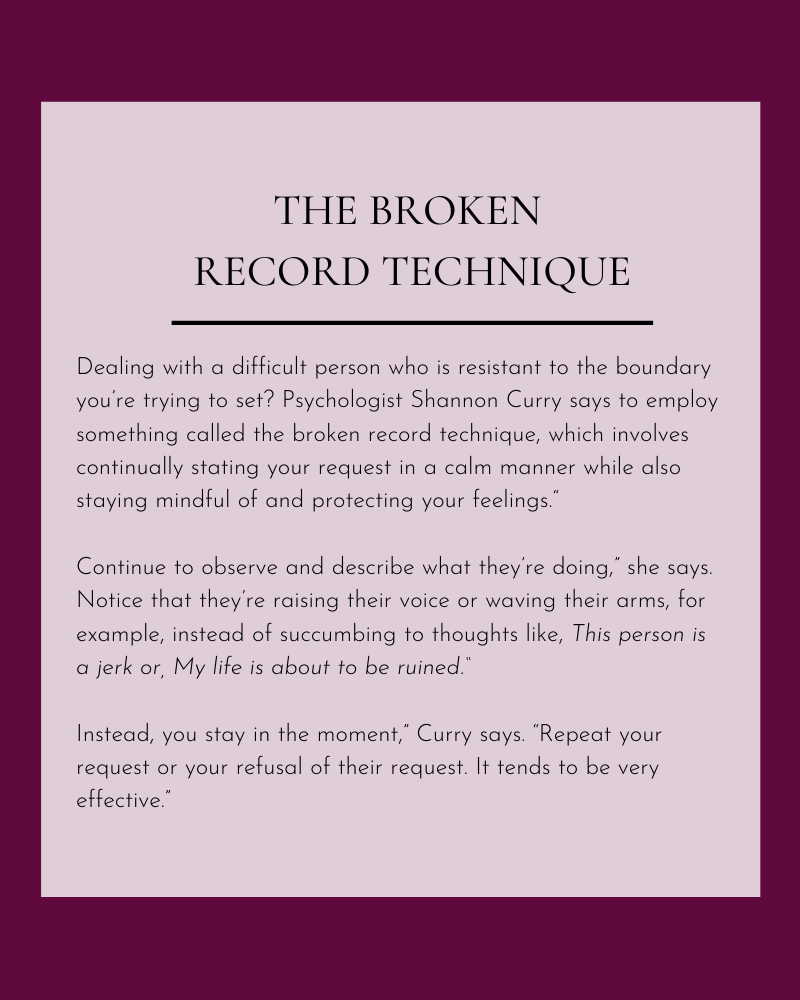
“People are more likely to respond positively to us making a request—or to us saying no to a request—if we’re calm, if we’re able to express our needs in a way that is fair and makes sense to them, and if we’re being respectful of the other person,” Curry says.
6: Check in with yourself regularly.
Boundary setting doesn’t mean saying no to every single thing we don’t want to do. “Sometimes we say yes to things we may not want to say yes to because close relationships are characterized by reciprocity,” Durvasula says.
To ensure you aren’t going overboard with boundary setting, it’s important to regularly take time for introspection. Is this relationship healthy and balanced enough that you feel comfortable occasionally doing things you don’t want to?
“[Boundaries] aren’t just about saying no,” Durvasula says. “In a healthy relationship, it’s all about context.”
* * *
If you’re struggling to get started, remember this: Anyone who reacts poorly to healthy boundary setting probably isn’t someone you want in your life to begin with.
“If someone is willing to reject you on the basis of you setting a boundary, it’s good to get that information early on,” Durvasula says. “You just dodged a bullet.”
For most people, summer is best spent going on that long-awaited family vacation, soaking up every ounce of sunshine possible, and checking off all those fun activities from your summer bucket list.
With some of the country still sheltering in place, that bucket list may not look like what you thought it would. But that doesn’t mean it can’t be a summer to remember! Instead of venturing to the beach or that amusement park, grab some books and learn how to be a better leader, dump those student loans, cultivate contentment, or map your steps to becoming an everyday millionaire.
Whoever said reading beachside is the only way to burn through your summer reads hasn’t picked up these books. Here are our top 12 books that are sure to make this summer your best one yet.
1. The Richest Man in Babylon
All of this coronavirus craziness probably has you ready to wade through all the financial nonsense out there and get back to the basics. We don’t blame you. The Richest Man in Babylon is full of financial wisdom that dates back to ancient Babylon. It’s probably what your great-grandma turned to for financial advice.
This Ramsey Press revised edition of George Clason’s classic shares stories of people who struggled with debt only to come out on the other side ready to build lasting wealth. It even includes Dave’s sound advice from The Dave Ramsey Show. This little book will inspire you to take a new look at your own finances and change your life.
2. The Proximity Principle
Around 70% of Americans are unengaged at their jobs.1 Sure, right now, many of us are blessed to even have jobs. But if you’re dreading Monday mornings, it might be time to start looking for new opportunities that will get you pumped to go to work each week. And you can work toward your dream job while you keep food on the table and gas in the tank.
Listen: You don’t have to stay in a job that’s just that—a J-O-B. Ken Coleman answers all the questions swirling in your head about how to network, gain a mentor, and close the distance between where you are right now and where your dream job is. So, go ahead—watch your kid do their 20th cannonball and then jump on into this incredible read!
For years, people have been spoon-fed the idea that student loans don’t really count as debt. But that’s a bold-faced lie. Student loans are the worst. It’s like going through a pandemic . . . and running out of toilet paper. Yikes.
National bestselling author Anthony ONeal has created this step-by-step guide on how to help get your kid through college without the loans and set them up for financial success. Kicking off your student’s future debt-free? That’s a gift that keeps on giving!
4. Destroy Your Student Loan Debt
In this 64-page Quick Read, Anthony ONeal gives you the ugly truth about student loans and how they’re actually hurting you. If you’re new to the Baby Steps and short on time, but want the facts on how to tackle those loans for good, this motivating read might be your favorite one of the summer. Anthony gives you a step-by-step plan on how to send those student loans packing—for good.
5. Smart Money Smart Kids
Give. Save. Spend. Teach your little ones the value of hard work when they’re young and they’ll be masters of their piggy banks (and their finances) as they grow. Father-daughter duo Dave Ramsey and Rachel Cruze team up to share their personal stories of raising money-smart kids (and growing up with a financial guru as a dad).
Dave and Rachel tackle the importance of teaching your kids where money comes from, the value of hard work, paying cash for college, living responsibly, and how to avoid debt like the plague.
6. Love Your Life, Not Theirs
Comparison is dumb. Not only does it make us want what others have but it makes us ungrateful for what we do have. (And let’s be real: When we want what others have, we’re probably going to spend ourselves broke.) Keeping up with the Joneses is overrated. Why? Because the Joneses are broke!
This is the perfect summer read. No matter what your summer looks like (or what it doesn’t look like), there’s still so much to be thankful for. Rachel Cruze will show you how to live the life of your dreams by wanting the life you already have, steering clear of debt, and leaving behind the stress. You won’t be disappointed.
7. Business Boutique
You know that dream that’s been cooking in the corners of your mind for the past few years? The one that keeps you up at night and makes your heart go pitter-patter? Yup—that one. Who says you can’t turn that dream into a real-life actual business? And who says you can’t make some serious money doing what you love? Send those naysayers packing and pick up this step-by-step guide by bestselling author Christy Wright.
This read is everything you need to know about how to start making money doing what you love. You’ll learn how to create a business plan, manage your time, market your brand, and sell your product. Oh, and all those nitty-gritty details like taxes, budgeting and pricing? Christy covers those too.
8. The Total Money Makeover
If you’ve never read this, you’re in for a treat. This isn’t just another boring book about finances and spreadsheets. Nope. This bestselling book is going to be one you can’t put down until you’ve read every last word.
Not only does it give you a proven plan for how to take control of your finances—once and for all—but it also tackles those etched-in-stone money myths you may have believed all your life. With real-life stories of people who have hit rock bottom and worked their way to the top, this book will inspire you, motivate you, and help you give your finances the makeover they deserve.
9. The Graduate Survival Guide
Turns out, the choices you make in college can lead to a successful future . . . or knock you down for years to come. This book by Anthony ONeal and Rachel Cruze talks about the five mistakes many college students make in college that cripple their financial future when they should be chasing their dreams.
This book lays out the honest truth when it comes to credit cards, student loans, dumb decisions and the mistake of not having a plan (or money) in college. If you’ve got a recent high school grad in the house, they’ll want to binge this—instead of Netflix.
10. Everyday Millionaires
All millionaires drive fancy cars, eat steak dinners prepared by their own personal chef, and only wear brand-name clothing, right? Wrong! Chris Hogan and his team conducted the largest study ever recorded on 10,000 U.S. millionaires. What they found was that millionaires actually live on less than they make, invest, use coupons, and avoid debt like the plague.
This summer read will burst those millionaire myths floating around and help you realize that you too can be an everyday millionaire. Dive in. You won’t be disappointed.
11. One Question
If you could ask Tony Dungy one question, what would it be? What about Malcolm Gladwell or President Jimmy Carter? Ken Coleman sat down with these amazing people (and many more) to ask them questions about leadership, integrity, parenting, reaching your full potential and more. Once you start, you’ll be glued to the pages, learning from the giants of our time.
12. The National Study of Millionaires
Remember that study Chris Hogan and his team conducted on 10,000 U.S. millionaires? We decided to share it with you. Have you always wanted to know the average amount a millionaire actually spends on their groceries? Or the stats behind just how many of them received an inheritance? The numbers will surprise you. This may not be the easy poolside read you’re used to, but if you’re one who loves research, this is right up your alley.
Well, what are you waiting for? Head over to our $10 (or less) Sale and stock up on these amazing reads for your summer bucket list. You’ll be inspired to change your life—for the better—in no time. Start making some good cash now; link in bio http://wordpress.com/refer-a-friend/RNlRO6gsz3AkwOnW0Wo3
Visualize the logo of a brand you love. Now, think about three words you associate with that brand.
When it comes to your business or career, you want people picturing specific things when they think of you. But in order to do that, you need to be intentional about establishing who you are and what it’s like to work with you. Think of this as your brand tattoo. It’s something timeless that never leaves you.
You want to tattoo who you are onto the heads, hearts and hands of the people you serve. Every single day, how you show up for your customer, how you comment, how you respond, how you do what you do—that leaves an imprint on everyone who crosses your path.
What have I been through in my own journey that allows me to speak with any level of authority or insight? Have I embraced what makes me me?
What results have I generated thus far that point to the difference I’m making?
Then, begin to infuse your brand throughout your business:
1. Only accept projects that are on-brand.
When a new opportunity presents itself, ask yourself: Is this on-brand for me? Will this contribute to the impact I intend to make?
When you’re off-brand, you’ll feel like you’re chasing shiny objects because you’re out of alignment. When you’re on-brand, you’ll feel like you’re in flow because you’re making an authentic contribution toward your intended impact.
2. Get inspiration from other leaders and influencers who are not in your industry.
Resist the temptation to focus only on your competitors—you’re likely to fall into the trap of imitating someone else. Instead, seek ideas from outside your industry. Don’t copy, but gain inspiration and strategy that you can uniquely translate into your own work.
For example, I’ve always been fascinated by how comedians brand themselves with a style of joke. I’m not a comedian, but I can apply that strategy to what I do.
3. Remember: What got you here won’t get you there.
Your brand should be timeless, but the way you translate it will change over time. Think about the brand you visualized at the beginning of this article. Have their product offerings changed? Has their messaging changed over time? Has their aesthetic changed?
Remain open to being taken in a fresh direction while also staying true to your principles and area of impact.
Now, visualize your own brand tattoo. What do you see?
Reading is one of the most effective ways of learning from others. Mentors write books to offer their life experiences to others, and gaining that knowledge can help you tremendously: Knowing that others have faced challenges similar to your own can help you gain a better perspective on what’s going on in your business.
A book that teaches you to become a better leader and entrepreneur is a valuable resource, so we asked 15 members of YECwhich books they would recommend to people wanting to find success in the coming year. Which titles will you add to your reading list?
1. The Alter Ego Effect
The new year is all about reinventing yourself and taking a step forward into the future. In The Alter Ego Effect: The Power of Secret Identities to Transform Your Life, author Todd Herman suggests that we add another element: creating an alter ego to boost our confidence and skills. Just as Clark Kent has Superman inside him, we all have a hero inside of us that is waiting for the time to put on a cape. I fully endorse this book so that everyone can unlock their potential.
Accidental Genius: Revolutionize Your Thinking Through Private Writing by Mark Levy is a book that describes the power of “freewriting.” Freewriting is the technique of writing continuously, without editing, for a fixed period of time. It allows your mind to expel “junk thoughts” before paving the way for truly brilliant and creative thoughts. This is a great book for anyone who needs to find creative solutions or wants to improve their writing in general.
You won’t fulfill your dreams, change the world or make an impact if you’re simply reacting to everyone else’s expectations and requests through a bombardment of emails, meetings, calls and commitments. Essentialism: The Disciplined Pursuit of Lessby Greg McKeown is a great guide for narrowing your efforts in order to proactively control your day so you can spend more time on what will produce the most success and happiness.
I enjoyed the book Choose to Win: Transform Your Life, One Simple Choice at a Time by Tom Ziglar. One of my favorite aspects of this book is that Ziglar talks extensively about how making seemingly insignificant changes in our lives can have a big impact on our future. People might make better choices if they are able to see the benefit of making a small change today.
Big Magic: Creative Living Beyond Fear by Elizabeth Gilbert is all about the habits, attitudes and approaches people should take in order to live their most creative life. And while this book is often recommended to artists, writers and other creative people, it’s also perfect for business owners that want to approach their everyday lives with more mindfulness and passion.
You Are a Badass: How to Stop Doubting Your Greatness and Start Living an Awesome Lifeby Jen Sincero is wildly popular and for good reason. Sincero breaks down why readers are better than they think at accomplishing what they want and reaching their goals. By learning self-confidence, you’re able to better lead yourself in the right direction and make your dreams a reality. It also helps break down the notion that all successful people are always confident in themselves, which isn’t true.
The Success Lie: 5 Simple Truths to Overcome Overwhelm and Achieve Peace of Mind by Janelle Bruland helped me grow on a personal and professional level. Bruland covers how we hold ourselves back by creating objections and overwhelming ourselves. Additionally, there are plenty of great details about how to find success when your business or ideas are far from mainstream.
Everyone needs to have negotiation skills. Most people think of negotiation as an “us versus them” situation.Getting to Yes: Negotiating Agreement Without Giving In by Roger Fisher and William Ury shows how you can find common interests that lead to great outcomes for all parties. This is an excellent book for business owners who want to have a better relationship with their partners and customers.
Your habits make up your days, which make up your routines, which make up your life. If you aren’t good at forming healthy, solid habits, then it’ll prove difficult to be successful. The Power of Habit: Why We Do What We Do in Life and Business by Charles Duhigg helps me stay focused on my habits and reset them when I need to so I’m constantly bettering myself.
The most memorable book I read in 2019 was Entrepreneurial You: Monetize Your Expertise, Create Multiple Income Streams, and Thrive by Dorie Clark. Revealing new business opportunities isn’t just a means to generate additional income, but rather exploring new channels for connecting with your audience, self-improvement, and both personal and professional development.
The Replaceable Founderby Ari Meisel begs the question: How much notice do you need to give your team to take a last-minute vacation? How much notice would they need to give you? If the answer is longer than 48 hours, this is a big red flag, and means that there are bottlenecks within your company that are preventing you from communicating effectively and having redundancy and safety in the organization.
The Third Door: The Wild Quest to Uncover How the World’s Most Successful People Launched Their Careersby Alex Banayan is all about how to pave your own way into success and that taking the unconventional path can pan out in your favor. It’s always good to have a plan and execute, but sometimes you need to zigzag instead of going in a straight line. If you want to find success, this is a great read to get you inspired and motivated to do whatever you need to do.
One hitch of starting a new year is that all the energy we have for a resolution fizzles out eventually. Gretchen Rubin is a remarkable writer and podcast host. She wrote The Happiness Project as part memoir, part self-help book about goals she set—12 projects for every month of the year. Decluttering her space was the simplest, while increasing happiness was the hardest. Eye opening and introspective!
It’s safe to say summer 2020 is going to be different than any other. “Make sure you stay at least 6 feet away from your friends in the pool, Timmy!” That is, if swimming pools are even open—who knows?
One thing we do know is that COVID-19 has changed what your typical summer would usually look like. The kids are already out of school, theme parks are shut down, and people aren’t going to be super eager to travel any time soon.
But there’s good news: This is a great time to save some money! Here are 20 money-saving tips to help you pocket some extra cash this summer. Mix and match ideas to create your own summer savings plan without sacrificing fun.
20 Ways to Take Advantage of Summer Savings
1. Trim up your entertainment budget by $100.
As things slowly start to reopen this summer, it’s going to be pretty easy to cut back on entertainment costs (after all, public gatherings might still be canceled in your area). So that will save you a lot of money right there. But when events start to pick back up where you live, make the most of the free stuff like outdoor concerts, movie-on-the-lawn nights, and free days at local museums. Set up your budget with EveryDollarto keep track of all your savings!Start budgeting like a boss with our FREE budgeting tool!
You can save even more by borrowing free DVDs from the public library or ditching cable and signing up for a streaming service instead of spending too much money at the movie theater. And let’s be honest, after the kind of spring we all just had, you probably aren’t exactly itching to go to a jam-packed theater anyway.
2. Pocket $400 by skipping the theme park and visiting a natural park instead.
Again, who knows when theme parks will even open this summer. But once they do open, skipping a trip can save you major bucks. The one-day ticket price for a theme park ranges from about $50 to well over $100 (thank you, Disney). That means a family of four could pay anywhere from $200–400 for just one single day of fun. Sheesh! Keep your cash and visit a state park in the great outdoors instead. Many parks are free or only charge a small entry fee per carload.
3. Earn $100 or more by doing a garage sale.
Who doesn’t love a good garage sale? More importantly, who doesn’t love the extra $100 you make from pawning your old stuff onto complete strangers? Now’s the time to hop on that spring-cleaning train, dig through the attic, and start planning for a garage sale. Well, you know, whenever you can stand less than 6 feet away from someone again.
If you just can’t wait to sell off your stuff, host a virtual garage sale. Post the photos and prices of the items online, let people Venmo you the payment, and all you have to do is drop the (sanitized) item off on their doorstep. Try apps like VarageSale, Letgo and Facebook Marketplace if you go the virtual route. All that money you rake in could go toward your next Baby Step, like building an emergency fund or paying off debt.
4. Skip the car wash and save $60–100.
Skipping the car wash six times this summer could save you $60–100! So grab the kids, get the suds, and start cleaning your own wheels. Or, let the nice summer rain take care of the job for you once in a while. Every week that you’d usually drive through a car wash, transfer $10 into your summer savings account.
5. Save nearly 20% on energy costs by caulking your windows and doors.
Your mom was right: There’s no need to air condition the entire neighborhood by forgetting to close your windows and doors. So go a step further and seal your doors and windows. This will help your air conditioner not have to work overtime—and it just might help you save up to 20% on your energy costs!1
6. Earn $50–100 when you sell your old clothes.
Spring cleaning is in full swing! Clean out your closets and take your pre-loved threads to a consignment shop, or sell your clothes from the comfort of your own home through an online marketplace like thredUP or Poshmark. You can put the money you make toward new school clothes for your kids in the fall or just add it to your summer savings fund.
7. Take advantage of a tax-free weekend and save hundreds on big purchases.
Check to see if your state (or one near you) offers tax savings for back-to-school buys. If so, wait until the tax-free weekend to buy things like school supplies, computers and clothes. It’s pretty outrageous how much taxes can add to your total price tag. So if you can swing it, just hold off until tax-free weekend to make those big purchases.
8. Save $200–800 on camp fees by creating your own.
Give it a go and try a camp-free summer (thanks to coronavirus rules, you might have to anyway this year). A typical one-week day camp can cost anywhere from $200–800.2 Multiply that by several kids and doing more than one camp throughout the summer, and the cost adds up to a small fortune!
Instead of having a summer camp bill that rivals a year of college tuition, just organize your own “camp” for your kids. Pick a theme and start making a plan. Get inspired by this list of free stuff to do with kids from Rachel Cruze. Ask friends and family members if they’d be interested in doing a video call with your kids for story time, craft projects or exercising. If you’d rather not take on the pressure of your own day camp, sign your kids up for virtual camps from across the country. Chances are, your kids will have just as much fun as they would at an expensive camp.
9. Shop smarter to save $20–50 each week.
Before the week even starts, compare the ads from your local grocery stores and plan your meals around what’s on sale that week. Then, make a shopping list and stick to it once you get to the store. Not tossing extra items into the cart is one of the hardest parts of grocery shopping, but sticking to the list will help you save a lot!
Want to save even more on groceries? Give generic brands a try, stick to a weekly meal plan, and buy fruits and veggies that are in season from your local farmers market.
10. Use coupons.
We know what you’re thinking—coupons, really? Do coupons save you money? Yes! You just need to know how to find the right ones. Your local grocery store probably has digital coupons through their app. And there are about a million different cash-back apps out there too. They give you rebates for buying a certain brand of orange juice or tomato sauce. Then after you rack up enough rebates, you can cash them out. It’s a pretty good gig.
You can even use coupons at your favorite restaurants and fast-food joints too! Look out for 10% off coupons, kids eat free nights and buy one entrée, get one free deals. Download your favorite restaurant’s app to save even more! Don’t forget sites like Groupon and Living Social that offer you a $20 gift card for only $10 bucks. Using coupons like this can really add up.
At the end of the day, there’s still no denying that some of the best coupons come from the weekly ads in the Sunday newspaper (you know, the pile of stuff you usually toss out). So take a second and see what they’re offering before you pitch it in the garbage.
11. Save $200–300 by packing your lunch.
Making your own meals is usually healthier and way cheaper than dining out, especially in the summer when fresh fruits and vegetables are everywhere (you could even grow you own!). Instead of going out to eat every day with your buddies, try making your own lunch two or three times a week. You could save $20–30 each week, which adds up to $200–300 over the course of the summer.
12. Skip the professional repairs and do it yourself.
Plenty of online tutorials teach you the basics of do-it-yourself jobs. Before you pick up the phone and call the professionals, give it a shot and see if you can solve the problem yourself. You’ll save money and maybe even learn something new! That’s a win-win for anyone.
13. Stock up on dollar store snacks before a road trip and save $25–50.
Road trips might look a little different this summer. But no matter where you’re headed for whatever reason, you can still save some money. If you normally stop for snacks while on the road, buying them at the dollar store ahead of time will help you not buy overpriced treats from a convenience store or gas station. Grab a plastic shoebox while you’re there so you can keep all the goodies organized for the road trip (yeah, even if it’s just a Sunday drive out in the country).
14. Look for discounts on your rental car.
Another thing that might look different for you this summer? Renting a car. Don’t pay full price for a car rental this summer! Be on the lookout for deep discounts from rental companies trying to get you to hit the open road.
Install a coupon finder like Honey onto your web browser so it can automatically look for coupons based on the car rental website you’re on. You could score a savings of 5–10%! And it’s time to kick the clunky process of renting a car with your debit card to the curb. Check out how Dollar Car Rental makes renting a car with your debit card easier than ever.
15. Keep your blinds and curtains closed during the day.
Yeah, you might feel like a vampire blocking out any shred of light creeping in, but the payoff could be worth it. The U.S. Department of Energy says that 76% of sunlight that hits standard double-pane windows enters to become heat.3 And that means your A/C unit will be cranking to try to produce the cool air in your house—which is bad news for your electric bill. If you still want to let natural light in (and we don’t blame you), open the curtains or blinds that don’t let direct sunlight in.
16. Wash your clothes in cold water.
Guess what? You can wash your clothes in cold water and they’ll still get clean. The U.S. Department of Energy says two of the best ways to cut down on the amount of energy your home eats up is by using lesswater and using a cooler water temperature. Just moving that temperature setting on the washer from hot to warm could cut each load’s energy use in half!4
17. Shut the doors!
It might sound weird, but keeping the doors closed to rooms you aren’t using could save you a bundle! Your A/C won’t have to keep pumping air to those closed rooms, which means it’ll have less square footage to cool off and it’ll work more efficiently doing it. Simple fixes like this can impact your energy bill in a big way.
18. Save $400–500 by pausing your gym membership.
Since gyms have been closed this spring, you’ve probably already discovered you can break a sweat without ever having to step into a fitness center. Take advantage of the warm weather and keep doing your workouts outside. Jog around your neighborhood, do yoga in the backyard, or even do a fitness class on YouTube. If you just suspend your gym membership during the warmer months of April–October, you could save about $400–500!
19. Find vacation discounts.
Alright, if you do want to give traveling a go this summer, you’re bound to find some great deals. Hotels, airlines and tourist hotspots are going to be doing all they can to try to seek out summer travelers. This means if you’re comfortable with traveling, you’re bound to save some major money. Search sites like Travelocity, Airbnb and Kayak to see how much you can save!
And don’t forget the beauty of a staycation. After being stuck in your house for weeks on end, it might be nice to hang out in your own neck of the woods for a while and explore your town again. Hit the park (remember those?) and kick back with a good read, like a book from our $10 Sale.
20. Save $700 by shopping for insurance with the help of an independent insurance agent.
You didn’t see that one coming, did you? This is one of Dave’s most popular money-saving tips because it’s so easy to do. Maybe you’ve outgrown your current coverage or you qualify for new discounts. An independent insurance agent can research all the options to find the best deal that’s right for you.
Most people save an average of $700 when they shop around for insurance with one of the agents Dave recommends. That’s nuts! Kick-start your summer savings by making sure you’re getting the best deal on insurance! Get a free quote from an insurance Endorsed Local Provider (ELP) today!
If we don’t learn good habits, life becomes more difficult. We have a choice: Get hard on ourselves so life becomes easier, or get easy on ourselves resulting in life getting harder.
Successful people choose good habits over a stagnant life. At first it might not seem like you are accomplishing much, but don’t be fooled. “Small hinges open big doors.”
Not all good habits are created equal. Some are more powerful than others. Here are four powerful habits that will strengthen your confidence, help you get what you want and result in a satisfying journey.
When things aren’t working, our first action is often resistance. Instead of resisting, take a moment to consider what isn’t working and why. This kind of information is valuable.
Tough times can be used to disrupt stagnant patterns in thinking. If we embrace the disruption, it can have a purifying effect that knocks off the rust and barnacles we naturally collect on our daily voyage. Embracing life is resisting stagnation.
Life might wreck your plans when your plans are about to wreck you. So pay close attention.
2. Affirm yourself, don’t degrade yourself.
One of the most common ways to degrade ourselves is to ask the wrong questions. Wrong questions are disempowering. They immediately change our subconscious thought patterns from positive to negative, or vice versa. They are powerful.
Question: Why can’t I lose weight? Answer: Because you’re a pig!
Question: Why can’t I do things right?Answer: Because you’re not smart!
Question: Why am I so broke? Answer: Because you’re a loser!
Ask a bad question and you’ll get a bad answer. This is how our subconscious mind works. Because the conscious mind programs the subconscious, take charge. Good questions lead to productive answers.
What are the top two things I can do to lose weight?
Blame-storming is using our creative abilities to come up with reasons why something is not our fault. This creates an emotional roadblock to healthy living called resentment. It comes from the Latin words “re” and “sentire,” which means “to feel over and over again.” It’s almost exclusively internalized, which makes it different from anger even though it can accompany the emotion.
It’s tempting to wallow in resentment because it provides a feeling of control. But that is an illusion. The past is no more. There is no control. How can we disempower the past from stealing the present? Through brainstorming, you come to the realization that your past deepens you but does not define you, deteryou or defeat you.
It is a part of your maturity but not your identity. Your past has made you stronger for today. You are not a prisoner of your past. You are a pioneer of your future. And you have power in the present.
4. Do something, not everything.
It’s good to be resilient—to a point. Sometimes quitting is the smartest thing to do. There are times when I look at my to-do list and complete one or two of the items quickly, just by eliminating them. For example, if I have 10 things on my list, Pareto’s Principle reminds me that 80 percent of my results comes from 20 percent of my effort. Let me get those top two done first and I’ll go from there. To not do this is to spread myself too thin. Time to prune the list.
The secret of concentration is elimination. This leads to productive living and has health benefits as well—a needed message for a society of high achievers.
Here is an exciting thought! Why not work full time on your job and part time on your fortune? And what a feeling you’ll have when you can honestly say, “I’m working to become wealthy. I’m not just working to pay my bills.” When you have a wealth plan, you’ll be so motivated that you’ll have a hard time going to bed at night.
So if you will indulge me, I would like to share a simple formula for creating wealth. Here’s my thought on how money should be allocated.
The 70/30 Rule
After you pay your fair share of taxes, learn to live on 70 percent of your after-tax income. These are the necessities and luxuries you spend money on. Then, it’s important to look at how you allocate your remaining 30 percent. Let’s allocate it in the following ways:
Charity
Of the 30 percent not spent, one-third should go to charity. Charity is the act of giving back to the community and helping those who need assistance. I believe that contributing 10 percent of your after-tax income is a good amount to strive for. The act of giving should be taught early, when the amounts are small. It’s pretty easy to take a dime out of a naira’s. But it’s considerably harder to give away a NGN100,000 out of NGN1 million. You say, “Oh, if I had NGN1 million, I’d have no trouble giving NGN100,000.” I’m not so sure. NGN100,000 is a lot of money. Start early so you’ll develop the habit before the big money comes your way.
Capital Investment
With the next 10 percent of your after-tax income, you’re going to create wealth. This is money you’ll use to buy, fix, manufacture or sell. The key is to engage in commerce, even if only on a part-time basis. So how do you go about creating wealth? There are lots of ways. Let your imagination roam. Take a close look at those skills you developed at work or through your hobbies; you may be able to convert these into a profitable enterprise.
In addition, you can also learn to buy a product at wholesale and sell it for retail. Or you can purchase a piece of property and improve it. Use this 10 percent to purchase your equipment, products or equity—and get started. There is no telling what genius is inside you waiting to be awakened by the spark of opportunity.
Savings
The last 10 percent should be put in savings. I consider this to be one of the most exciting parts of your wealth plan because it can offer you peace of mind by preparing you for the “winters” of life. Let me give you the definition of “rich” and “poor”: Poor people spend their money and save what’s left. Rich people save their money and spend what’s left. Twenty years ago, two people each earned a NGN50,000 a month and they each earned the same increases over the years. One had the philosophy of spending money and saving what’s left; the other had the philosophy of saving first and spending what’s left. Today, if you knew both, you’d call one poor and the other wealthy. So, remember that giving, investing and saving, like any form of discipline, has a subtle effect. At the end of the day, the week, the month, the results are hardly noticeable. But let five years lapse and the differences become pronounced. At the end of 10 years, the differences are dramatic. And it all starts with the same amount of money—just a different philosophy.









:max_bytes(150000):strip_icc()/shutterstock_203849551-5bfc3ae8c9e77c005147fd3a.jpg)


 suaznome16 hours agoAdvertisements
 Uroupa's blog